Faith and Life are being pushed out of the public square
We are in the midst of our fall fundraising campaign. What follows is why we need your support in Quebec to fight for faith, family and life, from conception to natural death.
Dear friend,
Two things happened in Quebec this week that shows what we are fighting against at Quebec Life Coalition.
A school that chose the faith over money
Loyola High School has stood in Montreal since 1896. Under Bill 9, the secularism law adopted in Quebec on April 2, 2026, Loyola can keep its provincial funding on one condition: that it stop being Catholic in any way that counts. Religious instruction could no longer aim at handing on the faith. Prayer, retreats and Mass would have to be optional, and held outside school hours.
Loyola said no. It is giving up $7,500 per student. Tuition will climb from roughly $12,530 to somewhere between $20,000 and $21,000 a year. A school with no scandal, no crisis, and applications at a historic high is being priced out of its own identity. The story is here.
That is what it looks like when faith is pushed out of the public square.
A candidate erased in a single day
Éric Lanthier, a pastor, was running as a candidate for the Conservative party of Quebec in Pontiac. On September 9 the Journal de Montréal described him as anti-abortion and "homophobic". The evidence against him: an article he wrote in 2015, published on our own website, arguing that "my body, my choice" is not a rational argument, and a post in which he said he was privileged to open the March for Life in Ottawa in 2019.
Within hours he withdrew, so as not to be, in his leader's phrase, a distraction. The media reported the speed of it with evident satisfaction. He is the first candidate of this election campaign to fall, and he fell for holding convictions that millions of Canadians hold quietly, at their kitchen tables, where nobody can photograph them. The story is here.
Our fall campaign is under way, and it is what pays for the work described in this letter. If what you are reading matters to you, please give at en.cqv.qc.ca/donate. Our goal is 25,000$ and we are only 3 weeks away from our deadline.
Why this should worry you wherever you live
Quebec is not a curiosity off to one side. What is settled in Quebec travels. Henry Morgentaler opened his first abortion facility in Montreal, and it was in Quebec that the law was first made unenforceable, before the rest of the country followed. Quebec legalized euthanasia in 2014, two years ahead of Ottawa, and has been widening it ever since. Two prime ministers (Trudeaus Sr. and Jr.) formed by this province, father and son, did the rest: one opened the door to abortion in 1969, the other shut his party's door on anyone who defends the child in the womb.
If the culture of death is not resisted in Quebec, it is not resisted in Canada. That is the plain truth of the last sixty years, and it is why this letter is addressed to you whether you live in Quebec or a thousand miles from it.
And yet Goliath sometimes loses
On July 31, the Superior Court of Quebec ordered former Tourism minister Caroline Proulx to pay more than $60,000, including $30,000 in punitive damages she must cover personally, for having ordered the cancellation of a Christian rally at the Quebec City Convention Centre in 2023 because the organizers were pro-life. The judge found she had acted arbitrarily and abusively, and that she had struck at freedom of expression itself. La Presse reported it here.
A minister used the power of her office to silence pro-lifers. Three years later a court told her plainly that the office gave her no such power. Someone had to be willing to bring that case, and to carry it for three years.
I bring up this case because it shows the power of tenacity, in the face of a culture of death.
What your gift pays for
Quebec Life Coalition keeps prayer and action together, as they should be. The vigil on the sidewalk. Help for women who are pregnant and frightened. The tool that has already put letters from ordinary people into the hands of candidates across most of Quebec's electoral divisions. The election guide. The daily reporting that tells people what actually happened, in a province where almost nobody else will. And lawyers, when the moment calls for them.
We are small. What we are facing is not. In close to 40 years (QLC was founded in 1989) that has never once been a reason to stop.
Our fall campaign runs to September 30. The goal is $25,000. Together we can do this, and we are asking you for your part of it today.
For Life,


Georges Buscemi
President, Quebec Life Coalition
P.S. $25,000 by September 30. Help us stand against the Goliath of the Culture of death in Quebec. Give today.
Be the first to comment.Éric Lanthier withdraws his candidacy in Pontiac after the media labeled him “homophobic” and “anti-abortion”

Éric Lanthier.
Blog post by Augustin Hamilton (Quebec Life Coalition) — Photo: Parti conservateur du Québec
Pastor Lanthier has withdrawn his candidacy in Pontiac, where he was running for the Conservative Party of Quebec, following several media reports about Mr. Lanthier’s statements on abortion and therapies for homosexuals seeking to overcome their same-sex attraction.
This is the first withdrawal among Conservative candidates in the 2026 Quebec election.
The media cited a blog post written by Pastor Lanthier and published on the Quebec Life Coalition website in 2015, titled “Abortion: ‘It’s my choice because it’s my body’ is an irrational argument”.
They also shared a post by Éric Lanthier on X in which he expressed his pride at having the privilege of opening the 2019 Ottawa March for Life.
The media also highlighted the fact that Mr. Lanthier supported ‘conversion therapy’: psychological or pastoral counseling for gay people who wish to overcome their attraction to people of the same sex.
Unbelievable, isn’t it? In a Quebec that’s supposedly ‘pro-choice’, this is a choice that shouldn’t even exist.
Éric Duhaime, leader of the CPQ, defended his candidate, asserting that the party was ‘pro-choice’ and that he himself was ‘gay’, while also noting that Mr. Lanthier had committed to following the party line.
Nevertheless, Éric Duhaime later announced that Mr. Lanthier was withdrawing his candidacy so as not to be ‘a distraction’ for the party. Had he remained in the race, the media would certainly not have failed to renew their attacks on the CPQ regarding this candidate, who was far more consistent in his positions than others.
As can be seen here, TVA Nouvelles proudly reports that the candidate stepped down just a few hours after the publication of their first article on his views. In fact, the media are more political influencers than news reporters. They wanted this candidate out, and they got him.
1 reactionLook at what you have achieved
In 26 days, on October 5, Quebec elects its government. For those twenty-six days, a candidate reads his email, takes his calls and shows up at the door. On October 6, that window closes for four years.
That is why we wrote to you last Saturday to put a very simple instrument in your hands: our election tool. You enter your postal code, the tool finds the candidates running in your electoral division, and it sends them six precise questions in your name, on:
- Bill 9 and religious freedom.
- Public funding of abortion.
- Support for women after an abortion.
- State support that would follow the child rather than the daycare spot.
- Medical assistance in dying.
- The rights of parents over mandatory school content.
Six questions that are answered yes or no, and the answer comes straight back to you.
Look at what you have achieved
In four days, 187 people used the tool and 625 letters went out to candidates in 83 of Quebec's 127 electoral divisions. More are going out today.
We mapped the result. Every electoral division in Quebec is there, shaded by the number of letters its candidates received. (Click to enlarge)
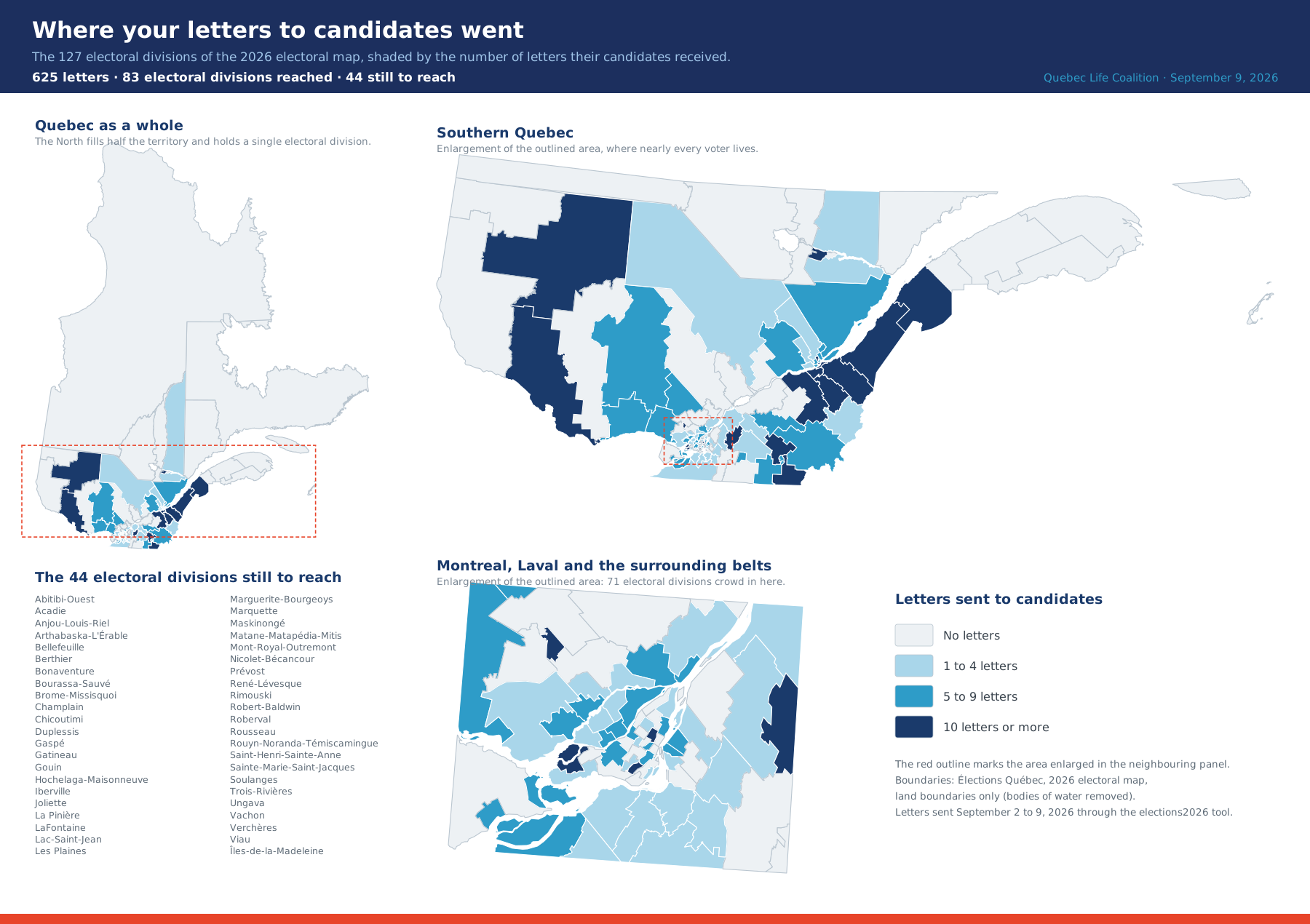
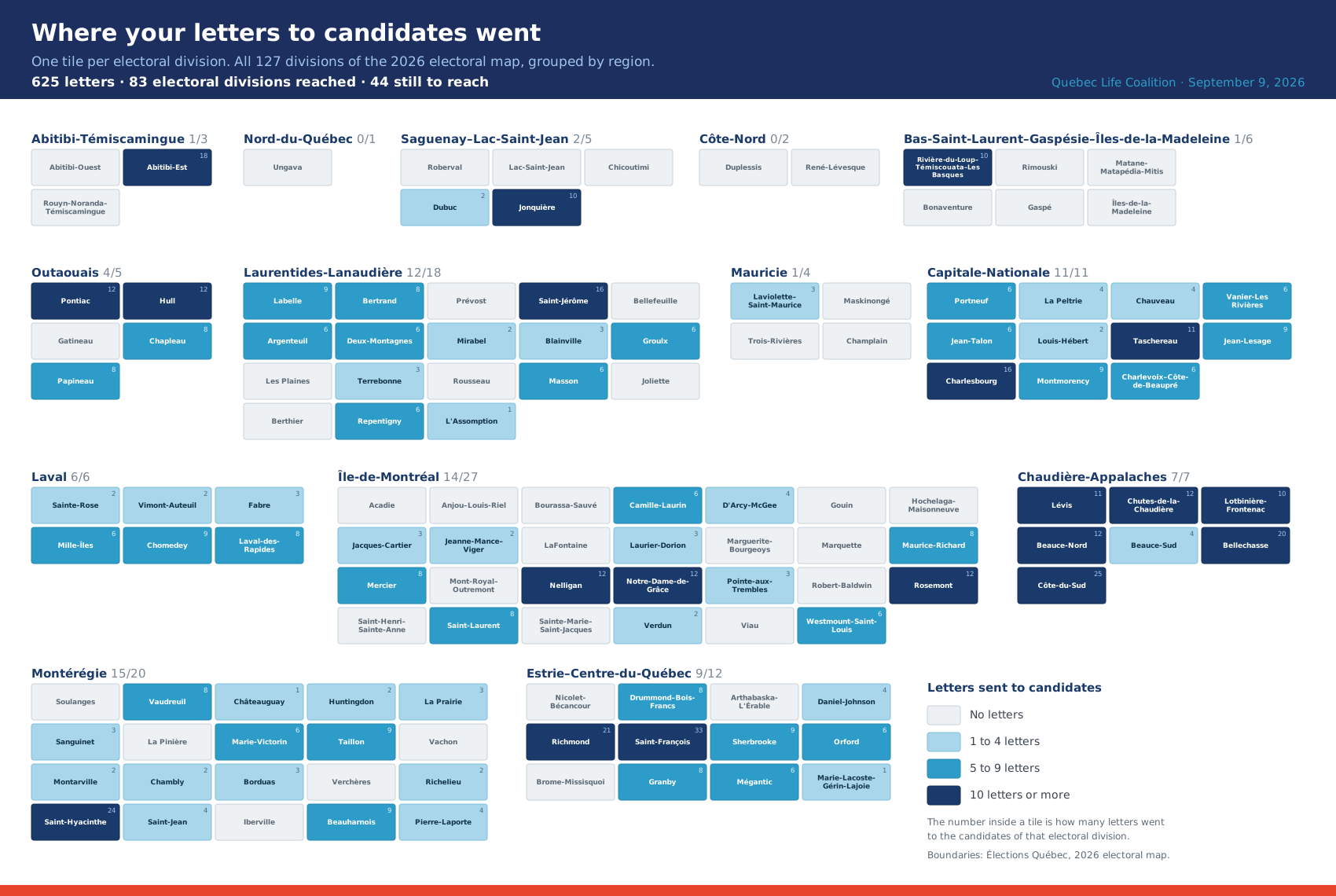
Three regions are already covered end to end: the Capitale-Nationale, eleven divisions out of eleven, Chaudière-Appalaches, seven out of seven, and Laval, six out of six. The south shore of Quebec City and the Beauce form a solid dark block without a single gap. The Eastern Townships and the Montérégie are close behind. And letters went out from places as far apart as Abitibi-Est, Pontiac, Jonquière and Rivière-du-Loup.
This is not our work, it is yours. All we did was build the machine; 187 people set it running, one at a time, each from their own living room.
Now look at the grey. Forty-four electoral divisions have not received a single letter yet. All of the Gaspésie, nearly all of the Mauricie, the Saguenay north of Jonquière, the Côte-Nord, and close to half the island of Montreal. On the island in particular, Robert-Baldwin, Marguerite-Bourgeoys, Marquette, Mont-Royal–Outremont, Acadie and LaFontaine are all still grey, and those are precisely the divisions where many of you live. If you have not written to your candidates yet, yours may well be one of them.
And above all, do not forget to send us the answers. That is the part we cannot do for you. When a candidate replies to you, simply reply to this email with his answer attached. We compile everything, division by division, and we also record who stays silent.
The election guide, as promised
We announced it on Saturday: it is online today. And it covers exactly the same six questions as the ones you are sending to your candidates.
The guide is not fixed, and that is deliberate. It will be revised and expanded as the days go by, as candidates' answers reach us and as the parties spell out their positions. Every box that is empty today can be filled in before October 5. Your letters, and the answers you forward to us, are part of what will fill them.
The printable PDF version, easy to pass around, is here.
Our Fall 2026 fundraising campaign begins
Today we are launching our fall fundraising campaign: three weeks, until September 30, with a goal of $25,000.
Before those three weeks are out, we will have a great deal to tell you. The election is far from our only front this fall, and you will hear about the others, on the ground and elsewhere. But a general election in Quebec will not come round again for four years, and it is being decided now.
Thank you for standing with us,


Georges Buscemi
President, Quebec Life Coalition
P.S. Our fall campaign ends on September 30 and the goal is $25,000. Make your gift today.
P.P.S. The 2026 Election Guide is online: where the five main parties stand on the six questions, with the sources. Read the guide here. It will be expanded as the days go by, so come back to it.
P.P.P.S. Forty-four electoral divisions have not received a single letter. Two minutes and a postal code are all it takes to get yours off that list. Write to your candidates here. And when they answer, forward us their reply.
Be the first to comment.There's an election, and lives are at stake. Here's your part in it.
Quebec goes to the polls on October 5.
It's a provincial election, so only Quebec residents will cast a ballot. But even if you happen to live outside Quebec, you are not a mere spectator. Quebec has been the laboratory for a good deal of what eventually spreads across our country — euthanasia was legal here before it was legal anywhere else in Canada — and what happens here on October 5 will not stay here.
So there are two things to read below. If you live in Quebec, there is something you can do in the next two minutes. If you don't, there is something we need from you just as much.
If you live in Quebec
Between now and October 5, every candidate in your riding wants something from you. You have one month in which they are obliged to listen, and many of them will not hear from a pro-life voter at all.
So we built something that takes two minutes (check the website, here).
You just need to enter your postal code. We show you the candidates in your riding. You read a letter carrying six questions, which you can edit if you want, and send. Each candidate receives his or her own copy, addressed to him or her by name, with your email address for the reply. Not a petition with your name buried among a thousand others, but a letter from a constituent, arriving alone in his or her inbox. Write to your candidates now → https://en.cqv.qc.ca/elections2026
One thing to expect: you may see only one or two candidates in your riding, or none at all. The parties have not all finished naming their teams, and Elections Québec is still registering candidacies daily. We refresh our list regularly. So, if your riding looks empty today, come back in a few days and try again.
Giving women the opportunity to care for their own children?
We are on the eve of the Quebec election period, and important issues have already been raised: family and birth rates. These topics, which are very meaningful to us, are more relevant than ever, so we thought it would be appropriate to report on the strange disagreement between Éric Duhaime of the PCQ and Christine Fréchette of the CAQ regarding the issue of child care.
We’ll provide an analysis of the policies proposed by the parties in the coming weeks.
In her critique of Éric Duhaime’s natalist plan, Christine Fréchette suggests that the Conservative leader’s program would undermine women’s autonomy. How? By offering them the option to stay home and raise their children themselves, by providing subsidies directly to families for child care rather than to day care centers — at the same time, Duhaime would also maintain the system of state-subsidized day care centers.

Éric Duhaime, leader of the PCQ.
So there are more choices, but Quebec’s premier suggests that this freedom offered to women will open the door to the following discussion in households: “If you go into the workforce, honey, we might not make it — unlike if you stay home.”
In her reaction, Fréchette implies that taking care of one’s own children rather than being in the workforce is regressive and suggests two things: first, that women are too vulnerable or weak to make a sound decision; second, that Fréchette knows better what’s good for them.

Christine Fréchette, leader of the CAQ.
Did you think feminism was about “choice”? Think again. Fréchette, who here acts as the spokesperson for a certain type of condescending feminism, believes it is wrong to offer women this choice, because they might choose something other than what female politicians had planned for them.
These remarks remind us of the feminist debates of the 1990s, when family allowances were introduced in Quebec. Some feminists at the time strongly criticized this initiative. Claire Bonenfant, then president of the Council on the Status of Women, questioned the intent of the familial policy in the following terms: “Will this policy be a natalist policy in disguise, seeking to send us back to the cradles and the kitchen, or does it present itself as a policy of social justice?”
Let’s also consider what Simone de Beauvoir, an influential French feminist thinker, said about women’s freedom to choose to stay at home:
“No woman should be allowed to stay at home and raise her children. Society should be completely different; women should not be able to make such a choice precisely because many of them would choose to stay at home.”

Simone de Beauvoir.
In Quebec, there is an anti-family mindset in the corridors of power — a mindset that the media conveys to the public, an ideology, in short, that permeates the culture. It would take much more than the subsidies Éric Duhaime is proposing to reverse Quebec’s declining birth rate; what is needed is to promote a culture that is supportive of family and life.
***
Life Chain
On Sunday, October 4th, the Life Chain will take place — or rather, the life chains, since it is a multi-location event. This is a peaceful demonstration in which participants hold pro-life signs for one hour to raise public awareness about the fate of unborn children. You can join one of the chains taking place across Quebec or, if you’d like, organize one yourself. Visit the Life Chain Quebec website for more information.
Petition for the Protection of Unborn Children
We invite you to sign our petition for the protection of unborn children in Canada, addressed to the Parliament of Canada.
For Life,
Augustin Hamilton
Can we debate abortion?
The remarks made two weeks ago by Martine Biron, Minister of Higher Education, in which she blamed a Quebec Conservative Party candidate for believing there should be a debate on abortion in Quebec, have sparked a wave of reactions that are worth examining.
One in particular, published in Libre Média and authored by Simon Demers, raises the question of the abortion debate: Has the debate taken place, and can we still talk about it?
In his opinion piece, Mr. Demers observes a desire to stifle any opposition to abortion, particularly in light of the incident involving the cancellation of a prayer event at the Quebec City Convention Center where abortion was reportedly among the topics to be discussed. He rightly points out that the media focused solely on the issue of free speech, but that “no one asked what these Christians were there to say.”
In his view, abortion is one of those issues that have not been “settled” through democratic debate, but are believed to be definitively closed because people have stopped discussing them.
In fact, he notes, in Quebec in particular, abortion ceased to be prosecuted when Justice Minister Marc-André Bédard — who had been sworn in just two weeks earlier — decided on December 10th, 1976, to stop enforcing the federal law in effect at the time. Then, 11 years later (11 years!), the Supreme Court of Canada handed down the Morgentaler decision, which fully decriminalized abortion. This was followed by a half-hearted attempt to legislate on the issue in the Parliament in Ottawa, which was abandoned in the Senate.
In a sense, ministers and judges have weighed in on abortion, but no real democratic debate has ever taken place.
Mr. Demers notes that the Catholic Church’s moral opposition to abortion was rejected along with the Church itself at the very moment this practice became socially accepted: “The argument regarding the status of this tiny being yet to come thus became inaudible along with the person who voiced it, without ever having been truly refuted.” Anyone who attempts even slightly to revive the “argument” is immediately suspected of dragging Quebec back into the “Great Darkness.”
What’s interesting is that he draws on certain pro-life arguments to justify the debate over abortion, particularly the one regarding the inconsistency in how we treat the unborn child: when wanted, he is considered a child — we choose a name for him and proudly show off the ultrasound; when unwanted, he is a “cluster of cells "...
While not a pro-life apologetic text, Simon Demers’ article does have the merit of raising the issue of the abortion debate; admittedly, it’s not a major media outlet, and I don’t expect its publication to spark any major media debates, but it is one more voice speaking out in a way that doesn’t simply ban any questioning of abortion.
***
Last Saturday, we held our annual corn roast. During this warm and welcoming event, our guest, lawyer Samuel Bachand, spoke to us about the provisions of Bill 9, known as the “Act to Strengthen Secularism in Quebec”, which prohibits public prayer, except in cases where municipalities grant an exception.
Describing Quebec’s secularist regime as, in fact, religious — particularly with its unacknowledged worship of nature — Mr. Bachand explained that the law likely did not target religious events of a cultural heritage nature, such as processions, but that overzealous officials could use it to cancel events they disapprove of — think, for example, of the 40 Days for Life campaign. He emphasized the importance of asserting our rights by requesting permission from municipalities to hold religious events so that, if approved, precedents would be set that we could rely on. Failing to act would mean we would gradually lose ground in the face of Quebec’s secularization.


Petition for the Protection of Unborn Children
We invite you to sign our petition for the protection of unborn children in Canada, addressed to the Parliament of Canada.
Life Chain
On Sunday, October 4th, the Life Chain will take place — or rather, the life chains, since it is a multi-location event. This is a peaceful demonstration in which participants hold pro-life signs for one hour to raise public awareness about the fate of unborn children. You can join one of the chains taking place across Quebec or, if you’d like, organize one yourself. Visit the Life Chain Quebec website for more information.
For Life,
Augustin Hamilton
Former Minister condemned for canceling an event organized by pro-lifers
Finally, some good news! The Quebec Superior Court ruled that the cancellation of an event at the Quebec City Convention Center in 2023, deemed “anti-abortion” by Caroline Proulx, was not based on any rule or law, and has therefore ordered the former Quebec Minister of Tourism to personally pay the sum of $60,000 to Harvest Ministries International, the event’s organizer.
This outcome is good news for the pro-life movement in Quebec and may give politicians pause before openly discriminating against pro-life advocates.
Éric Duhaime, leader of the Quebec Conservative Party, recently stated that he would leave no room for debate on abortion within his party, “We have always been a pro-choice party, and that policy will not change in the slightest,” he recently asserted, adding, “I can tell you that there will be no debate within our ranks on this issue.”
The reason for this statement is that the conservative candidate in Chutes-de-la-Chaudière, Dominique Dumas, a former host at CHOI Radio X, reportedly posted comments on social media in the past in which he said he was open to restricting abortion and also expressed discomfort with late-term abortion.
The candidate attempted to exonerate himself by stating that he would not address this issue within the conservative party and that he had not entered provincial politics to discuss this topic.
In vain! Martine Biron, Minister for the Status of Women, was quick to criticize Mr. Dumas: “Making these kinds of statements is an attack on a right that Quebec women have fought hard to win. The consensus in Quebec is clear: the right to abortion is a fundamental right.”
But is the consensus in Quebec really as clear as Ms. Biron claims, particularly when it comes to late-term abortion? That’s what she would have us believe...
***
Corn Roast
On August 15, Quebec Life Coalition will hold its traditional corn roast at our offices at 3330 rue Rivier in Montreal. This year’s speaker is lawyer Samuel Bachand, who will discuss in French the consequences of Law 9, which bans public prayer.
Don't forget to register by replying to this email or by contacting Brian Jenkins at (438) 930-8643. Please also let us know how many people will be joining you; this will help us organize the event.
Cost: $15 per person aged 12 and older. Free for children under 12.
Petition for the Protection of Unborn Children
We invite you to sign our petition for the protection of unborn children in Canada, addressed to the Parliament of Canada.
Life Chain
On Sunday, October 4th, the Life Chain will take place — or rather, the life chains, since it is a multi-location event. This is a peaceful demonstration in which participants hold pro-life signs for one hour to raise public awareness about the fate of unborn children. You can join one of the chains taking place across Quebec or, if you’d like, organize one yourself. Visit the Life Chain Quebec website for more information.
For Life,
Augustin Hamilton
The Superior Court of Quebec Rules Against Caroline Proulx for banning an event she deemed “anti-abortion”

Caroline Proulx.
Blog post by Augustin Hamilton (Quebec Life Coalition) — Photo: video screen shot/POP Montréal/YouTube
Do you remember when Tourism Minister Caroline Proulx canceled an event organized by Harvest Ministries International at the Quebec City Convention Center in 2023?
After being informed by Sébastien Bovet, head of Radio-Canada’s parliamentary bureau, that the Protestant and pro-life group was going to hold an event at the convention center, Mrs. Proulx checked the websites linked in the event’s advertisements. (Yet another example of journalists seeking to influence politics and create a news story.)
To her horror! She read on HMI’s website that the group opposes abortion, stating that its decriminalization "has led to the abortion of some 4 million babies to date" and "has made the mother’s womb the most dangerous place for a child in Canada." Outraged by what she considered false information contrary to Quebec’s fundamental values (strange values that are causing French Canadians to gradually disappear...), she rushed to cancel the contract between HMI and the Convention Center. However, no regulation or law allowed her to cancel an event based on the contractors’ beliefs just a few days before the event was scheduled to take place.
1 reaction Read moreÉric Duhaime Will Leave No Room for Debate on Abortion Within His Party

Éric Duhaime.
Blog post by Augustin Hamilton (Quebec Life Coalition) — Photo: screen shot/TVA Nouvelles/YouTube
"We have always been a pro-choice party, and that policy will not change in the slightest," Éric Duhaime recently assured. He added, "I can tell you that there will be no debate within our ranks on this issue."
So why does Mr. Duhaime feel the need to reassure the political and media establishment of his adherence to the dominant ideology? It's because we're in the pre-election period, a time when candidates' pasts are dragged out of the closet, and when candidates and their leaders are asked to burn a grain of incense at the altar of abortion.
It just so happens that Dominique Dumas, the Quebec Conservative Party candidate in Chutes-de-la-Chaudière and a former host at CHOI Radio X, has reportedly posted comments on social media in the past in which he said he was open to restricting abortion and expressed discomfort with late-term abortion.
1 reaction Read moreA Surrogate Mother is Sued for Refusing to Have an Abortion

McKenna West.
Blog post by Augustin Hamilton (Quebec Life Coalition) — Photo: McKenna West
McKenna West thought that offering her services as a surrogate mother would provide extra income for her family, while helping a couple have a baby.
Through a surrogacy agency, the Alaskan woman entered into a contract with an American couple. During a 20-week ultrasound, doctors diagnosed the baby she was carrying with hypoplastic left heart syndrome (HLHS), a condition that can be treated.
When the couple learned that the baby they had “ordered” had this defect, they told Mrs. West to abort the baby. McKenna West could not bring herself to terminate the pregnancy, but she feared being sued. When one of her brothers offered to adopt the child if the couple no longer wanted it, she resolutely decided not to abort the baby.
Faced with Mrs. West’s refusal to have an abortion, the couple stopped sending her money and demanded that she return the money they had already sent her, as well as pay them compensation for not having an abortion (which is illogical, since it doesn’t change anything for them...).
1 reaction Read more