
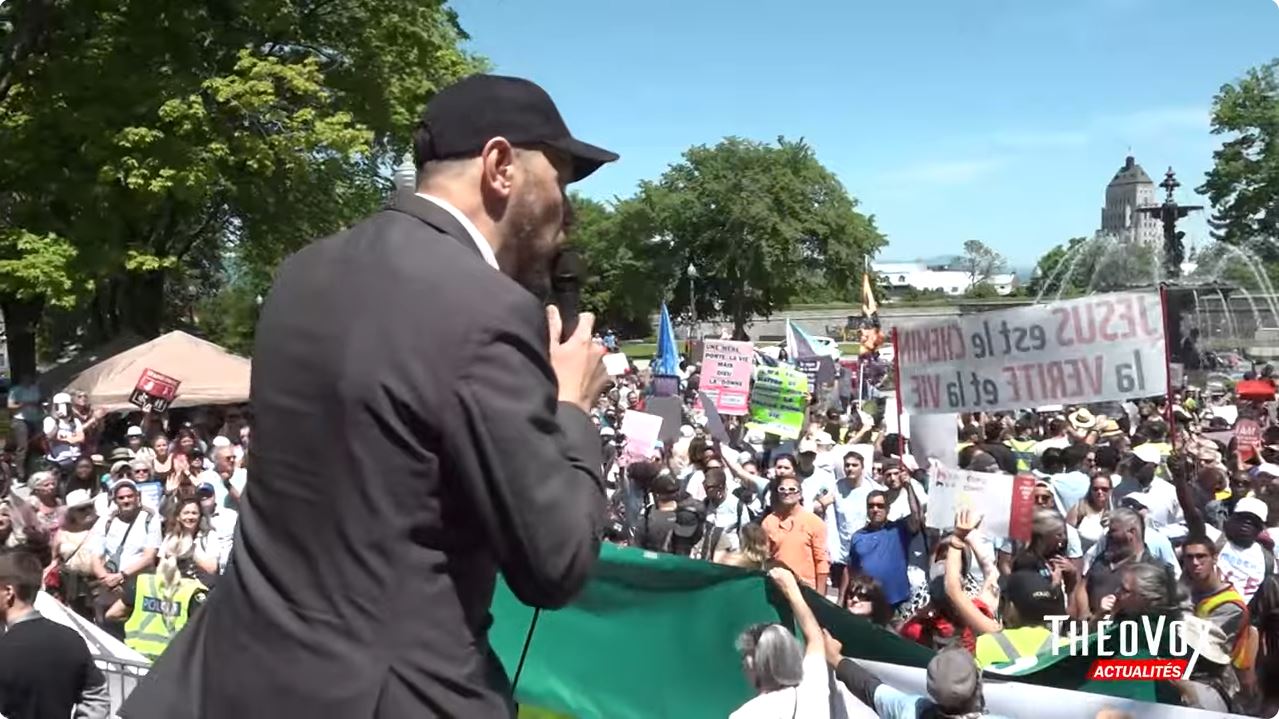
Georges Buscemi addressing the crowd during the first Quebec March for Life, June 1st, 2024.
In this interview from March 12th, 2026, Georges Buscemi, president and spokesperson for Quebec Life Coalition, explains to an anthropology student at Cégep de Lévis the foundations of his commitment, his organization’s vision, and his perspective on the major moral, cultural, and political issues of our time.
Presentation of Quebec Life Coalition
Student: To begin, could you introduce yourself and explain what your movement is, its foundations, and its core values?
Georges Buscemi: My name is Georges Buscemi. I am the president and spokesperson for Quebec Life Coalition. We are a Christian organization whose goal is to foster the emergence of a Christian society that defends faith, family, and life, from conception to natural death.
Georges Buscemi’s specific role within the organization
Student: As spokesperson, what is your specific role within the organization?
Georges Buscemi: In a small organization, employees and volunteers wear many hats. So I’m not just president and spokesperson. I’m also, among other things, fundraiser, writer, web technician, and partly responsible for social media.
There are a huge number of tasks to accomplish. But if I had to summarize my main goal, I would say this: to communicate our principles, our philosophy, and our faith to the general public, in the hope that one day these beliefs and principles will be embraced and put into practice on the political, cultural, and social levels.
The turning point: discovering the reality of abortion
Student: What led you to join this movement?
Georges Buscemi: To be specific, I was a religion student at McGill, planning to pursue a doctorate in theology. I watched a video about abortion as part of an event organized by a pro-life group that I had joined somewhat impromptu, mainly to meet people.
It was that video that deeply shook me. It wasn’t just the reality of abortion that struck me, but also the contrast between what I saw and the way the world usually presents itself to us. The world presents itself as a place of pleasure, pleasant experiences, consumption, and comfort. But behind the frosted glass of an abortion clinic lies the brutal killing of tiny babies.
It had a profound effect on me. One day, as I was sitting in a Starbucks, I had this image: everything seemed smooth and pleasant on the surface — the cup, the decor, the comfort — but inside my cup of coffee, there was blood. It was this contrast between the pleasant surface and the hidden reality that shook me to the core.
To borrow a well-known image, it was a bit like in The Matrix: the red pill. I had seen something real. I could either pretend I hadn’t seen it, or accept that this discovery imposed a moral obligation on me. I decided that no, I couldn’t go back. I had seen what I had seen. It was a human being, a child. And from that moment on, something had to change — or, at the very least, I had to refuse to participate in it.
A minority movement, but one convinced it holds a moral truth
Student: Would you say the Quebec pro-life movement is popular? Is it strong?
Georges Buscemi: If it were strong, there would currently be a political party advocating what we advocate. That is not the case. The movement is therefore weak, at least culturally and materially. It is weak in resources, but strong in principle.
It is a small consolation, but it is real: the truth is on our side. The problem is that human beings have often shown, throughout history, that they are willing to compromise morality for their own comfort. Slavery is one example. Human beings were treated like animals, all while justifying it on the grounds of economic utility. Today, similar arguments are used regarding unborn children.
We are therefore in the minority and lack resources. Our opponents include the current government and certain ministers. We can mention Martine Biron and Caroline Proulx. We are in their crosshairs. Reports have even been written claiming that “disinformation agents” like us should be neutralized. Meanwhile, their budgets are enormous. The Ministry of Health, which promotes an ideology opposed to ours, has approximately $50 billions per year at its disposal. We, on the other hand, get by on a few thousand dollars a week.
The number of supporters
Student: Are there still a lot of you?
Georges Buscemi: We don’t have a formal membership system like a political party. But if we use the number of annual donors as an indicator of membership, we’re looking at about 1,200 to 1,300 people per year.
Ties to a broader movement
Student: Is the Quebec movement directly connected to the one in the United States or to other groups elsewhere in the world?
Georges Buscemi: There is no direct hierarchical structure, but there are alliances of spirit and occasional collaborations. For example, we participate in the March for Life in Washington, the largest in the world.
Quebec Life Coalition is also part of a broader Canadian network, in conjunction with Campaign Life Coalition. This network maintains international contacts, notably in Washington and at the United Nations. At the time of this interview, we even have representatives at the UN within the Commission on the Status of Women, to counter pro-abortion lobbying and coordinate with other groups.
Roe v. Wade: a historic victory
Student: What do you think of the overturning of Roe v. Wade in the United States in 2022?
Georges Buscemi: For us, it was fantastic. Roe v. Wade was a major target. The ruling dated back to 1973 and had shaped the entire history of the American pro-life movement. Seeing it overturned, some fifty years later, represented a historic victory. It is probably the most significant victory of the pro-life movement.
The moral impact of this victory on Quebec
Student: Do these changes influence the Quebec movement?
Georges Buscemi: Yes, especially on a moral level. It shows that things can change. It’s not hopeless. We’re seeing in real time that mindsets and laws can be transformed. That encourages us. Personally, I’ll continue to reject the lies and reject the system. But if, on top of that, it becomes possible to win, that’s even better.
The society Quebec Life Coalition aspires to
Student: What kind of society does Quebec Life Coalition aspire to?
Georges Buscemi: A society founded on charity — that is, on love for one’s neighbor. In the Gospel, a Pharisee asks, “Who is my neighbor?” Jesus reverses the perspective: instead of looking for who deserves my help, we must become the neighbor to others ourselves.
For me, this means that the question is not primarily whether the other person is worthy of help, but whether I am willing to help. It is a society in which the burden is shifted to the one who can help. This, in my view, is the cornerstone of a Christian society.
In this context, the real question is not whether the unborn child is human — that seems obvious to me — but whether we have the courage to go out of our way to help. When we refuse this responsibility, we instead seek to deny the child’s humanity and move on. That is where we slip into an inhuman, mechanical, nihilistic society. We, on the other hand, want a humane society, founded on charity, and therefore a Christian one.
Religion as a reality to be taken seriously
Student: What role does religion play in the movement? Is it the foundation of the movement?
Georges Buscemi: For me, religion is as self-evident as certain physical realities. If I let go of this cup, it falls. Similarly, there are spiritual realities that have an effect, whether we acknowledge them or not.
We believe that if a society ignores these realities, it will pay the price. It may fall into decline, or even face the threat of extinction. I believe that French-Canadian Quebecker society is under threat today, particularly in demographic terms. The age pyramid is inverted, and this points to a profound decline.
Secularism, as it is understood today, is dangerous because it claims to completely eliminate the religious dimension of collective life. Many Quebecers react against certain forms of religion — often Islam — and end up rejecting all religion indiscriminately. But that is going too far. Religion is not a mere optional extra, like sugar in coffee. It is a dimension of human reality that cannot be eliminated without consequences.
A base predominantly composed of women and older peoples
Student: Are there more men or women in the movement?
Georges Buscemi: At work, the current team is mostly made up of men. We’ve also had female staff members, for example working part-time or on translation projects. But among our donors, it’s roughly 50-50.
On Facebook, however, when we look at the statistics, the people who most strongly identify with our message tend to be women in their 40s, 50s, and older.
I believe there are two main reasons for this. On the one hand, some women, after navigating their family lives, find themselves one day with more time to reflect on past experiences — sometimes painful ones, such as an abortion. On the other hand, life experience itself often leads people to recognize the real-world effects of abstract ideas. Over time, some people become more conservative because they see the concrete consequences of certain social changes, particularly regarding abortion and the decline of the family.
Modern feminism and moral subjectivism
Student: Do you think the feminist movement is linked to the popularity of the pro-choice movement among women?
Georges Buscemi: Yes, I believe the two go hand in hand. For me, modern feminism is a product of modernity — understood as the vision that emerged from the Enlightenment, according to which each individual is, in a sense, their own god, free to determine right and wrong for themselves.
I consider this view to be profoundly mistaken, even absurd. For if every individual is that sovereign, what defines right and wrong, and what legitimately prevents them? We end up with no foundation other than the so-called “general will,” which, in the end, is nothing more than an obscure, democratically sounding concept serving as a smokescreen for the enforcement of an anti-morality where “might makes right.”
There are undoubtedly forms of feminism that simply assert that women have the same dignity as men and must be respected. That is something else entirely. But mainstream feminism, as it is often formulated today, strikes me as a form of radical moral subjectivism, influenced by a certain brand of existentialism, where action precedes being, and where any biological, moral, or metaphysical constraint is denied.
From there, it becomes easy to justify abortion: first by saying that the child is merely a cluster of cells, and then, even if one suspects that it is a human being, by asserting that the woman’s will, supported by society (the “general will”), must prevail.
Women, nature, and social roles
Student: In your opinion, what is the place of women in today’s society?
Georges Buscemi: First, we must define what a woman is. We are sexual beings. There are men and women, and women have the ability to carry a child and give birth. This has real consequences.
This does not mean that every woman must fulfill exactly the same role, but it does mean that there are natural tendencies. Men will often be more present in physical or dangerous professions: the military, construction, law enforcement, etc. This is not necessarily an injustice. It is often a reflection of a natural disposition.
Modern feminists want to deny nature and reduce everything to social construction. I think this is a mistake. It is obvious that differences exist. While we must certainly allow highly talented women to develop their gifts in all fields, we must not deny the fundamental realities related to motherhood, family, and social continuity.
We must also address the demographic issue. A society cannot survive without renewing itself. This does not mean that we should impose a single destiny on women. It means that we cannot act as if having children has no societal significance.
Contraception: a “lie incarnate”
Student: What is your view on contraception?
Georges Buscemi: I believe that contraception is wrong. In my opinion, it is actually the opposite of what many people assume. People often say: if you’re against abortion, you should be in favor of contraception. I disagree.
I believe that good and evil depend on respect for human nature. Contraception strikes me as a kind of embodied lie. The sexual act is a sign of commitment. It is an act that has meaning, that is ordered toward life, and that implies a lasting self-giving. Contraception amounts to physically saying “I love you,” while removing what that act truly implies. That is why I consider it a form of deception.
Ultimately, contraception also indirectly promotes abortion, because it creates an expectation: that of not having a child. When it fails, some come to believe that an abortion is their due.
Extreme cases: rape, teenage pregnancy, minors
Student: Should the ban on abortion also apply in extreme cases, such as when a minor is the victim of an assault?
Georges Buscemi: These are obviously extremely difficult situations. But, in my opinion, the effort must be made by the family and society, and the price should not be paid by the innocent child.
In the case of rape, for example, it is the father who committed the crime. Killing the child for this crime strikes me as a complete injustice.
In the case of a very early pregnancy, for example in a 13 or 14-year-old girl, the situation is serious, certainly, but it does not necessarily lead to death. There are medical solutions, including early cesarean section, and there are social solutions such as adoption. This requires imagination, support, and sacrifice, but it does not, in my view, justify the termination of the child.
Family, rupture and cultural vicious cycle
Student: Does the breakdown of the traditional family model contribute to the emphasis placed on the right to abortion?
Georges Buscemi: Yes, because a way of life and a way of thinking influence each other. A broken family, marked by selfishness, rupture, bitterness, and a loss of trust, often produces a more individualistic view of human life.
When trust is destroyed, relationships become superficial. And when a child comes into this environment, it becomes easier for one of the two to withdraw and say, “I don’t want a child. Figure it out yourself.”
It’s a vicious cycle. And this cycle cannot be broken simply by arguments. Sometimes it takes what I would call grace: an inner jolt, an awakening, a call to action.
Short, medium, and long-term goals
Student: What are the movement’s medium and long-term goals?
Georges Buscemi: In the short term, for Quebec Life Coalition, the goal is clear: to grow. To grow in influence, funding, and organizational capacity. This involves events like the Quebec March for Life or Génération Vie, fundraising, petitions, social media, expanding our database, and eventually hiring more staff.
In the medium term, the situation becomes harder to predict. But what I observe is a marginalization of Western culture in a world that is becoming multipolar. The West is no longer in the position of dominance it held after World War II.
In this context, we’re seeing a sort of underlying civil war between progressives and conservatives. Where progressives dominate, such as in Quebec or parts of Europe, they’re accelerating their agenda — whether it involves abortion, euthanasia, or other moral transformations. Elsewhere, in more conservative countries, we’re seeing reactions aimed at preservation. I’m thinking in particular of Hungary, which is trying to distance itself from progressive Europe.
Quebec, in all of this, remains a fragile place: eight million people, caught between the rest of Canada and American influence. This makes for a rather tumultuous future.
I acknowledge that Donald Trump has done some things I appreciate on the domestic front, but I consider him unpredictable on the international stage. If someone like JD Vance were to succeed him, that might perhaps be more beneficial to our cause. But even in that case, I think that in Quebec and Canada there would undoubtedly be a progressive backlash in response to the United States. So, in the medium term, we should expect increased attacks against groups like ours. In the longer term, however, I think that certain ideological barriers might eventually come down.
Final thought: moral truth or mere preference?
Student: Finally, is there anything else you’d like to add?
Georges Buscemi: Yes. The pro-life, pro-family, and pro-God movement isn’t simply proposing opinions or personal preferences, like choosing an ice cream flavor. We’re proposing what we believe to be truths: moral and spiritual realities.
People need to understand this if they want to grasp our purpose. We sincerely believe that these things have a real foundation. We do not think this is merely an exercise of arbitrary will or of struggle for power.
We are often accused of trying to impose our values. That’s not how I see it. We propose looking at reality as it is, and then acting accordingly, both individually and socially. That’s what any political or social movement does when it identifies a problem and proposes a solution.
For us, quite simply, reality isn’t limited to the material world. It also has a moral and spiritual dimension. And if we accept that, then Quebec Life Coalition makes sense.
I therefore encourage people to visit our website, check out our Facebook page, sign up for our weekly newsletter, but also to face the reality of abortion head-on, to see what it actually entails, and to ask themselves: aren’t this flesh, these bones, these fingers, these little feet, human? And if so, what does that compel us to do?
Showing 1 reaction
Sign in with
Facebook