A letter from a psychologist opposing euthanasia for people with mental illness

Blog post by Augustin Hamilton (Quebec Life Coalition) — Photo: lightfield studios/Adobe Stock
In an open letter published in Le Quotidien, Georgia Vrakas, a psychologist and associate professor in the Department of Psychoeducation and Social Work at the Université du Québec à Trois-Rivières, explains why the extension of euthanasia to people suffering solely from mental illness, which is due to come into force on March 17th, 2027, is a bad idea.
Having suffered from bipolar disorder herself, she describes the difficulties that people with mental illness face in accessing housing, employment and adequate care. She is surprised by the push to extend euthanasia to these people under the pretext of “equality”, given that so much work still needs to be done to reduce the discrimination they face in daily life. According to Le Quotidien:
"They are among the most stigmatised, discriminated against, and marginalised groups in society. This leads me to wonder: we go to great lengths to ensure that people living with mental illness are not discriminated against when facing death, but who goes to such lengths when we are discriminated against on a daily basis while still alive? Do we really want medical assistance in dying to become our default option?"
Praising the work of suicide prevention organisations, from which she has previously benefited, she expresses concern about the impact this extension will have on suicide prevention. She rightly points out that there is no real difference between ‘assisted suicide’ (or euthanasia) and suicide. She also questions whether there is a real difference in suffering between someone who takes their own life and someone who undergoes euthanasia:
"Let’s use the right words. In both cases, it involves intentionally ending suffering through death."
"The difference lies in who is taking the action. Is the suffering the same or different in each case? We do not know because, to date, there has been no validated tool to distinguish between the suffering of a person with a mental illness who wishes to die by suicide and that of a person with a mental illness who wishes to die with medical assistance."
"In my view, providing medical assistance in dying for people with mental illness issues runs directly counter to suicide prevention efforts. What will happen if the law changes? Will people who are suicidal turn to MAID instead of suicide prevention centres? I don’t know. Given our current knowledge and collective responsibility, we should not make medical assistance in dying the default option for people living with mental illness. In reality, it is not a choice."
Left To Face Detransitioning Alone: Rose’s Story

Blog post by Augustin Hamilton (Quebec Life Coalition) — Translated by QLC — Photo: zinkevych/Freepik
Rose, now 21, has had a difficult journey. During her childhood, she suffered several traumatic experiences and was bullied at school. She says that these struggles led her to want to dissociate herself from the person she was, to leave behind the Rose who was suffering so much. She even attempted suicide twice.
At one point, she discovered people online who identified as transgender and had undergone or were undergoing the transition process. After seeing numerous posts by these people and contacting them, she became convinced that transitioning was the solution to her problems. When she told her mother that she believed she was a boy, her mother didn’t think she was serious. Throughout her daughter’s transition, she feared that she was mistaken and would come to regret it.
Faced with her daughter’s determination to transition, Danielle, her mother, sought advice from the Meraki Clinic (which specialises in gender transition) to understand what her daughter was going through, fearing that her distress might lead her to attempt suicide again. After two visits, the clinic prescribed puberty blockers, convincing Danielle that this would give her daughter a ‘break’ to reflect — without mentioning any potential side effects.
Read moreThe healthcare system will not cover the costs of a young woman from Quebec undergoing detransition

Blog post by Augustin Hamilton (Quebec Life Coalition) — Translated by QLC — Photo: Freepik
A young woman who underwent a transition process between the ages of 13 and 17 laments that the healthcare system which supported her during the transition is now abandoning her as she seeks to detransition, according to Le Journal de Montréal:
“I was supported during my transition to become a boy when I was aged 13 to 17,” says Rose Guérin. “But now, suddenly, there are no more services for me.”
The young woman, now 21, underwent a double mastectomy at 16, but at 17, just before what the Le Journal de Montréal article refers to “the big operation” (presumably a hysterectomy), she changed her mind:
“I burst into tears and called my mum to tell her that I wasn’t a boy; I’d just always been a girl who felt very uncomfortable in her own skin.”
Fortunately, she, who dreams of having children, was able to regain her fertility after stopping her transition treatments. However, she will not be able to breastfeed:
Read more“I have a flat chest with two large scars and I will never be able to breastfeed. However, by stopping the hormones, I have become fertile again.”
John Cleese cancels British Columbia tour over fears of LGBT censorship

John Cleese.
Blog post by Augustin Hamilton (Quebec Life Coalition) — Translated by QLC — Photo: Paul Boxley/Flickr/Wikimedia Commons
The famous British Monty Python actor and comedian, John Cleese, has cancelled his visit to British Columbia, which was scheduled to take place as part of his Canadian tour in the autumn.
His reason? He is undoubtedly afraid of being sued for making jokes about gender ideology.
In response to the news of the British Columbia school board member convicted for criticising gender ideology, John Cleese wrote on X:
“What a pity !
I'm arranging a theatrical tour of Canada this Fall, and now I won't be able to risk doing any shows in British Columbia
I was really looking forward to coming.”
School board trustee Barry Neufeld was fined $750,000 by the British Columbia Human Rights Tribunal for ‘hate speech’ targeting transgender people. The Tribunal found that at least 24 of Mr Neufeld’s posts on transgender issues were hateful and discriminatory. He was also found to have denied the reality of gender and incited hatred towards transgender people by denying that gender was a real thing.
In his role as a school board trustee, Mr Neufeld was striving to protect pupils from gender ideology, particularly as taught in the SOGI 123 programme.
The problem with this ruling is this: can we still criticise a group’s ideology if such criticism might expose its reprehensible aspects?
Meanwhile, Canada is not looking good when it comes to freedom of expression.
Remarks by Georges Buscemi at the May 12th press conference in Ottawa

From left to right: Georges Buscemi of Quebec Life Coalition, Jack Fonseca, Josie Luetke, Pete Baklinski, and Brandan Tran of Campaign Life Coalition, and Aleš Primc of the Movement for Children & Families.
Georges Buscemi, President of Campagne Québec‑Vie — English reference version
Ladies and gentlemen, good day.
My name is Georges Buscemi. I am the president of Campagne Québec‑Vie.
In 2025, Quebec officially became the world champion of euthanasia. 6,268 Quebecers died by "medical assistance in dying" last year — 7.9% of all our deaths. Thirty‑six percent of all MAiD deaths in Canada take place in our province, even though we make up only twenty‑two percent of the Canadian population. And in March 2027, this "assistance" will be extended to people suffering solely from mental illness.
How did we get here?
Let me first recall two Quebec voices — voices that are not my own. Denise Bombardier, shortly before her death, was struck by the fact that the only political consensus that ever forms in Quebec forms around a law about death, and she put the question bluntly: "Is the weight of a culture of death pressing down on us?" Patrick Lagacé, writing in La Presse this past April, stated in black and white that Quebec is the "world champion" of MAiD, and he called this "a blind spot" that must be confronted.
Why us, and not the others?
In 2010, I submitted to the Quebec government's Special Commission on the Question of Dying with Dignity a brief titled A False Freedom: 50 Years of Euthanasia in Quebec. In it, I predicted a scenario: institutionalized despair, a vicious cycle, a society that would end up eliminating poverty by eliminating the poor, and illness by eliminating the sick. I was called an alarmist. Fifteen years later, I'll let you judge for yourselves.
Read more“Seeing reality as it is”: an interview with Georges Buscemi
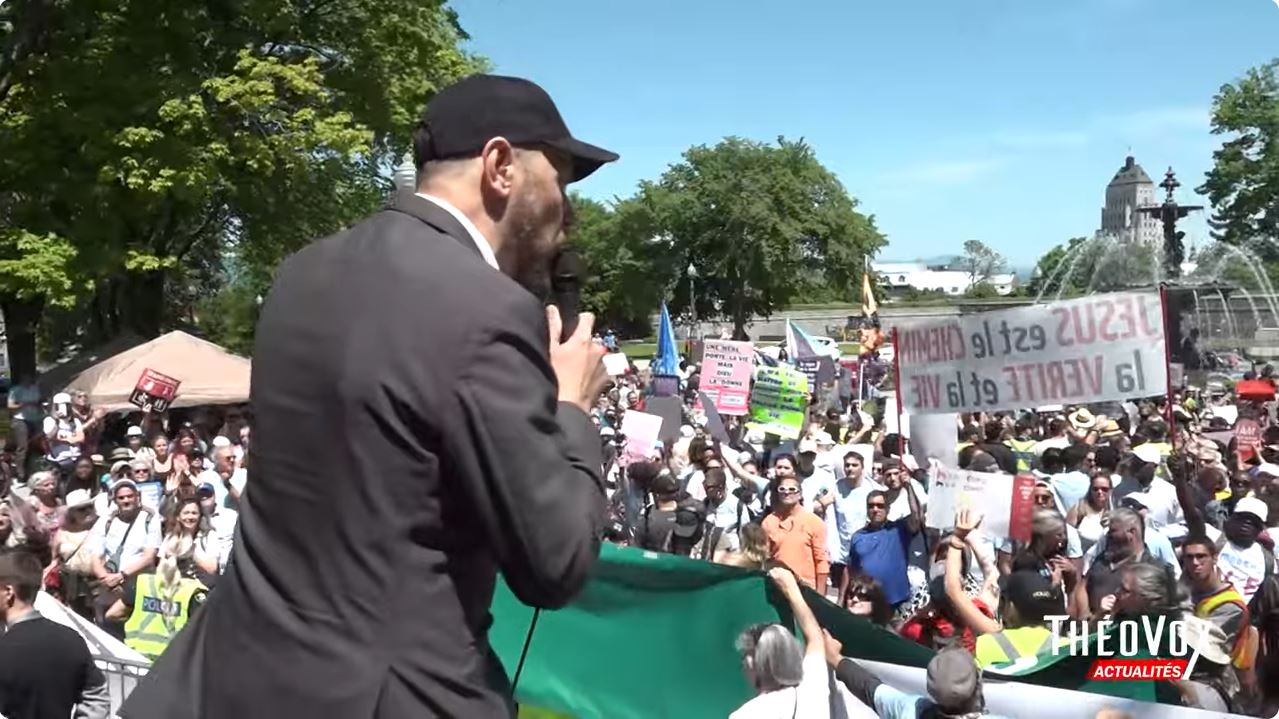
Georges Buscemi addressing the crowd during the first Quebec March for Life, June 1st, 2024.
In this interview from March 12th, 2026, Georges Buscemi, president and spokesperson for Quebec Life Coalition, explains to an anthropology student at Cégep de Lévis the foundations of his commitment, his organization’s vision, and his perspective on the major moral, cultural, and political issues of our time.
Presentation of Quebec Life Coalition
Student: To begin, could you introduce yourself and explain what your movement is, its foundations, and its core values?
Georges Buscemi: My name is Georges Buscemi. I am the president and spokesperson for Quebec Life Coalition. We are a Christian organization whose goal is to foster the emergence of a Christian society that defends faith, family, and life, from conception to natural death.
Georges Buscemi’s specific role within the organization
Student: As spokesperson, what is your specific role within the organization?
Georges Buscemi: In a small organization, employees and volunteers wear many hats. So I’m not just president and spokesperson. I’m also, among other things, fundraiser, writer, web technician, and partly responsible for social media.
There are a huge number of tasks to accomplish. But if I had to summarize my main goal, I would say this: to communicate our principles, our philosophy, and our faith to the general public, in the hope that one day these beliefs and principles will be embraced and put into practice on the political, cultural, and social levels.
Read moreAnalysis of Bill C-9

By Augustin Hamilton (Quebec Life Coalition) — Photo: motortion/Adobe Stock
Bill C-9, entitled “Combatting Hate Act”, introduced by Mark Carney's Liberal government on September 19, 2025, poses a serious threat of censorship to the freedom of expression of Christian, pro-life, and pro-family Canadians, whose words are often labeled “hateful” by their opponents for the simple reason that their discourse criticizes the ideology of the latter.
As far as we are concerned, C-9 proposes:
- to redefine hatred,
- to create a new category of “hate-motivated” offenses as an aggravating factor in the commission of a crime.
- and to facilitate the prosecution of “hate crimes” by removing “the requirement that the Attorney General consent to the institution of proceedings for hate propaganda offences".
“Hatred” (understood here as a feeling) has been defined by case law as follows in the Supreme Court of Canada's decision in R. v. Keegstra: “hatred connotes emotion of an intense and extreme nature that is clearly associated with vilification and detestation,” and "Hatred is predicated on destruction [...] [It represents] an emotion that, if exercised against members of an identifiable group, implies that those individuals are to be despised, scorned, denied respect and made subject to ill-treatment on the basis of group affiliation."
However, Bill C-9 defines “hatred” as follows: “the emotion that involves detestation or vilification and that is stronger than disdain or dislike.” We can already see that the definition is much vaguer and does not include the idea of mistreatment, for example, which opens the door to varying degrees of interpretation within the courts and commissions responsible for judging cases of “hatred.”
Read moreOn Quebec's Proposed Constitution: A Grave Step Backwards for Life and Memory

Statement from Georges Buscemi, President of Quebec Life Coalition – Photo: video screenshot/LCN
On October 9, 2025, the Legault government tabled a bill aiming to provide Quebec with its own constitution. Among the so-called “foundational principles” of this constitution is the “freedom of women to obtain an abortion.” Campagne Québec-Vie strongly denounces the inclusion of such a principle, which consecrates the deliberate elimination of an unborn human being as part of Quebec’s foundational identity.
We are outraged — but not surprised. For far too long, Quebec has been institutionalizing the erasure of its spiritual roots, its long tradition of defending life, and even its very sense of human solidarity.
It is worth noting that the proposed constitution carefully refers to a “freedom” to abort, and not a “right” to abortion. This semantic nuance betrays a certain discomfort. For to proclaim a right to abortion would be to affirm that abortion is, in itself, a morally good act — a claim that even pro-choice advocates are often reluctant to defend publicly.
Read moreQuebec Life Coalition Press Release: Response to the Superior Court Decision of July 28, 2025

Par Quebec Life Coalition – Photo: maylim/Adobe Stock
The recent decision by the Superior Court upholding the legality of “buffer zones” around abortion clinics in Quebec is deeply disappointing, though not surprising. Sadly, it confirms a growing trend toward progressive illiberalism observable throughout Canada.
Alarming Proliferation of Buffer Zones in Canada
Initially limited to abortion facilities, these “buffer zones” are now spreading to other contexts: schools, daycares, places of worship, and various community sites (Toronto, Vaughan, Calgary, Ottawa). This expansion reflects a retreat of freedom of expression, indicating that authorities no longer consider this freedom as fundamental, but rather as conditional—perhaps even bothersome.
The Emblematic Case of Sean Feucht
Recent events involving Christian artist Sean Feucht clearly illustrate this trend. Several of his concerts in Canada, notably in Quebec City and Halifax, were canceled under the pretext of security concerns and “hateful” views—simply due to his pro-life stance, support for Trump, and criticism of LGBT ideology. This points to a climate of growing intolerance toward any public expression of Christian or conservative convictions.
Read moreReflections on the 2025 March for Life in Quebec City

By Georges Buscemi (Quebec Life Coalition) — Photo: Augustin Hamilton
We are often reminded that we live under a so-called "liberal" regime, that is, a system founded upon "fundamental freedoms": freedom of religion, assembly, and expression. In Quebec, this liberalism is supposed to be protected by the Quebec Charter of Human Rights and Freedoms, adopted 50 years ago. Whether or not we agree with all its principles, in theory, we should be living under this rule of law.
However, the reality experienced during our March for Life on May 31, 2025, clearly demonstrates otherwise. If we truly had the right to peacefully demonstrate and freely express ourselves in the public square, the police would not have allowed a group of counter-protesters to intimidate us and drown out our speeches with whistles, shouting, and smoke from smoke devices. Nor would they have tolerated repeated disruptions of our march, nor permitted hostile agitators to infiltrate and openly violate our right to peaceful assembly.
Logically, the police should have intervened decisively to restore order. Acting firmly against these counter-protesters would not have violated their rights, for anyone actively working to deny the rights of others forfeits the right to complain when prevented from causing harm. A thief cannot seriously cry injustice when stopped from committing further theft.
Read more